If you work with ClickHouse from a desk, there’s a good chance JetBrains DataGrip is open on one of your monitors. It’s an excellent SQL IDE: a real query console, autocomplete that understands your schema, refactoring, a schema tree you can navigate, and one window that talks to every database you own. For writing and iterating on queries, exploring tables, and building things, it’s hard to beat.
Then an alert fires while you’re on the train, or at dinner, or asleep, and none of that is in your pocket. That gap is what ProbeDeck covers: an on-call companion for the hours DataGrip sits on a desk you aren’t at.
DataGrip lives on the desk
DataGrip is a desktop application. There is no real DataGrip on an iPhone: the JetBrains IDEs are built for a keyboard, a large screen, and a workflow where you’re sitting down to work. That is the design. A desktop SQL IDE is optimised for authoring SQL: long editing sessions, complex joins, comparing result sets, generating DDL, keeping ten consoles open.
Even a hypothetical DataGrip-on-a-phone wouldn’t solve the on-call problem, because a query IDE and an operational monitor are different tools. At 2 a.m., half-awake on a cellular connection, you are asking “is the cluster okay, and if not, can I stop the bleeding?” A blank query console is the wrong shape for that answer. You’d be typing SELECT … FROM system.processes ORDER BY elapsed DESC from memory on a touch keyboard while ingestion backs up. During an incident you don’t want to be writing SQL at all.
What you give up on a phone
On a phone you lose the things DataGrip is best at: the big query editor, multi-statement consoles, side-by-side result comparison, schema refactoring, the comfort of a keyboard. If your task is “write a gnarly analytical query,” the phone is the wrong device and DataGrip on the desk is the right one. Nothing mobile changes that.
Most on-call work is a small, repeatable set of questions:
- How many queries are running, and is one of them eating the cluster?
- Is any replica lagging or gone read-only?
- Are we accumulating too many parts, or is a disk filling up?
- Is a mutation or merge stuck?
A purpose-built view answers those without an IDE, and that is the slot ProbeDeck fills.
What a ClickHouse-native mobile tool covers
ProbeDeck is built for exactly the on-call slice, and specifically for ClickHouse rather than as a generic SQL front-end:
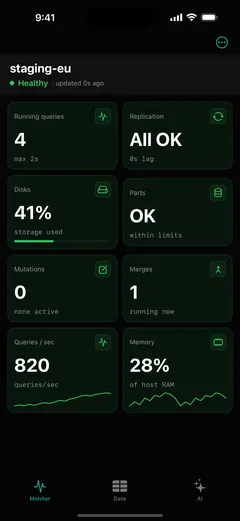
- A monitoring dashboard built from the
system.*tables: health tiles for running queries, replication, disks, parts, merges, and memory, each graded healthy, warning, or critical. You get a verdict before you ask a question. - Running queries and kill. Read
system.processes, find the runawaySELECT, and terminate it. The kill sits behind a type-to-confirm step (a Pro feature) so you don’t fat-finger production. - Replication health from
system.replicasandsystem.replication_queue:absolute_delay,queue_size,is_readonly. Replica lag is a ClickHouse-specific failure a generic tool won’t surface. - Parts, merges, and metrics: the storage-pressure and background-work signals that tell you whether “too many parts” or a stuck merge is behind the alert.
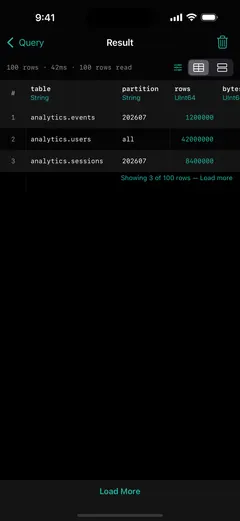
And for the times you do need a query, it’s there: a read-only SQL runner and a bounded data browser are free, and write/DDL statements are available under the Pro unlock. That covers the “let me run one thing” moment without pretending to be a full editor.
Where DataGrip still wins
ProbeDeck is no replacement for DataGrip on the desktop, and I wouldn’t want it to be. When you’re building, whether writing migrations, developing a reporting query, exploring an unfamiliar schema, or refactoring across tables, a desktop IDE with a real editor and a keyboard is the correct tool, and DataGrip is a very good one. The phone doesn’t compete there.
The framing is complementary. DataGrip covers development at the desk, and ProbeDeck covers the incident in your pocket, the stretch between an alert firing and you deciding whether this needs the laptop.
Reaching production safely from a phone
Pointing a mobile app at a production cluster raises the stakes, so the trust model matters as much as the features:

- Credentials stay on the device. Hosts, passwords, TLS material, and SSH keys live in the iOS Keychain and Secure Enclave. There’s no account, no backend, and nothing is proxied through the developer.
- Connect over TLS or an SSH bastion. ProbeDeck talks to ClickHouse over its HTTPS/TLS interface, or through an SSH tunnel to reach a cluster behind a firewall.
- Monitoring is read-only by nature. Watching health and reading
system.processeschange nothing; anything that does change the cluster sits behind a confirmation step.
There’s also an optional Pro AI assistant: natural-language-to-SQL and plain explanations like “why is my replica lagging?”, running on your own Ollama instance or your own API key. It’s bring-your-own-key, so nothing goes to the developer either.
Keep DataGrip, add the pocket monitor
Keep DataGrip; it’s the right tool for the desk. A desktop IDE cannot be in your pocket during an incident, and a query console is the wrong shape for 2 a.m. anyway. A ClickHouse-native mobile monitor answers the operational question, is it okay, and can I stop the bleeding?, hands you the one safe action, and gets out of the way.
ProbeDeck is a native iOS ClickHouse client: free monitoring and read SQL, with a one-time Pro unlock ($19.99) for killing queries, writes, and the AI assistant. No subscription.
Related: A native ClickHouse client for iOS · Monitor ClickHouse from your iPhone · A TablePlus alternative for ClickHouse on iPhone